Showing posts with label parenting books. Show all posts

Thursday, December 8, 2016

Oh Crap! Potty Training: a review

It's been a long time since I reviewed a parenting book, but I really liked this one. I have read (or at least skimmed) one or two other potty training books that I found at my library, but was really disappointed. They had about 5 pages dedicated to how to handle potty training and the rest was... I don't really remember what it was about, but probably amping you up and answering questions.

This one was different. (Yay!)

Oh Crap! Potty Training by Jamie Glowacki

Cons:

I felt really bad about my muddled potty training with Levi. I'm sorry, dude, I had no idea I was doing it wrong. The author really lays it on thick about potty training at the right time, especially before the kid's 3rd birthday and is completely unapologetic. I guess this is a pro just disguised as a con because I felt so bad. However, I really love how adamant the author is about needing to get potty training done within a certain window and what the consequences are for your child if you don't.

Language. It's occasional, but if you're offended by that kind of thing, be forewarned.

I've read better how-to non-fiction books, even parenting books. I would have liked it if this one were a little more scientific, but I'm not sure if there's very much scientific research out there that has been done on potty training besides whatever the diaper companies do, and they're biased.

Pros:

Simple and direct instructions on how to teach your child to use the potty. I felt like the author spelled it out well enough that I could follow her method confidently.

Dedication to the parent's judgment and making sure the parent is committed to potty training once and for all.

Relates potty training to learning any other skill, and reminds us of this throughout the book. 

Emphasizes that learning to use the potty correctly is a life skill and it's more important than getting a head start on other things that people are teaching toddlers these days (eg ABCs, colors, shapes, basic math, etc).

Conveys confidence in any 2-year-old's ability to master potty training. The point is made that if they're smart enough to learn to count, the ABCs, or anything else like that, then they're smart enough to learn to use the potty correctly.

Humor. Again, it can get a little on the potty humor side, but what do you expect from a book called "OH CRAP! POTTY TRAINING"?

Helps you look at potty training from the child's point of view, which helps with any problems that may come up

Encouragement to keep going even through accidents and discouragement. I feel like there is a realistic time schedule set, not the 3 days that I'd like but suspect won't happen (even though she says that's possible, but not every kid will get that). My biggest difficulty the first time through was expecting that if I did it right and at my child's pace, there would be few, if any, accidents.

Overall, as I'm sure you can tell, I liked this book. I have a lot more confidence going into my 2nd potty training having read it.

____________________________________________________


Post potty-training thoughts:

This book helped me understand a LOT more about the way a toddler thinks about potty training, diapers, and bodily functions, haha. I thought the process would take a lot longer than it actually did, because the author prepares you for the longest-case scenario. Also, I think sometimes underwear can be a positive motivator. You want to wear underwear like Mommy, Daddy, and your older sibling(s)? Okay. But you have to keep it clean and dry!

One thing that the book either didn't talk about at all or only very little was siblings and how they'd be affected by potty training. Levi was ultimately EXTREMELY helpful (I can't emphasize it enough. He was amazing), but at the beginning, he didn't know how to help and actually made it harder for Cecil to learn. Some ideas or examples of how potty training with siblings goes down would have been helpful.

My two-year-old was so excited to do his business in the potty (and all the associated stuff with that) that he would only pee or poop a little bit, flush it down, then repeat. Seriously. For at least half an hour at a time, if not more. Thankfully, when we had a discussion about where poop and pee go and gave him some underwear to put on, he is much more efficient with his potty use. Yay!

Cecil did better as soon as we had a talk about where pee and poop goes (in the potty, of course). Before that, most of his accidents were when he was wearing pants, and sometimes he'd ask for pants or a diaper when it was time for him to use the potty. The book was spot on about how pants/underwear feel more like a diaper than otherwise. His other accidents were at night in bed.

Last night was our first all dry night, and he's been wearing underwear today. We've had a couple of outings--our longest yesterday--and he's done well in the van and in public areas. I think I'm safe to say that the hardest part of potty training is over--and amazingly, it took less than a week!

Monday, August 10, 2015

Books I've read lately: August 2015

Recently I have read--among others--these books:

A Home Concealed Woman: the Diaries of Magnolia LeGuin
This book was incredibly interesting! Magnolia was born in northern Georgia in the late 1860's. The diaries were written from about 1900-1913, if I remember correctly. It was fascinating to read about her life! Much of what she wrote about was child bearing and rearing and the mundane duties around the house. I really related to a lot of what she wrote. It was also interesting from a family history point of view to read about a life that was similar in many ways to my predecessors.

Beneath these Waters
This book was based on historical studies done about the people who lived in a particular area on the northern part of the Savannah river, now covered by a lake (Russell Reservoir) made by the construction of a dam just north of Augusta. I got to read about prehistoric inhabitants (Paleo American Indians and more recent American Indians) as well as people that we have more recent records for. I got different perspectives than I've come across previously. I was glad to get a glimpse of what Reconstruction was like in the South, but it wasn't discussed in depth (understandably). I enjoyed the parts about the archaeological excavations and their finding more than the rest of it.

Welcome to Your Child's Brain
All about brain development, organized by subject, not age. It was a very interesting and informative read.

At Home with Pictures
This book has a lot of helpful ideas on how to decorate with pictures. I thought it was comprehensive and gave me a lot of ideas for decorating my own home.

Tuesday, March 3, 2015

Playful Parenting: my review

This review is for the book Playful Parenting by Lawrence J. Cohen.

I really enjoyed reading and learning from this book. The only thing that really bothered me about it was that the author seemed to think that his way was the only good and proper way to raise children. Considering that my favorite parenting advice is, "read lots of parenting books, take what you like from them, and discard the rest," it's understandable that I don't agree with his disdain of other parenting methods. I think it's valuable to take concepts from several different parenting techniques and use what works best for your family. Going along with that, his section about discipline was a bit confusing. He said don't be harsh but also set limits for the kids. Maybe it's because I'm still new to the whole "playful parenting" thing, but using his methods for setting limits backfired for me, and it was like I hadn't set limits.

Now on to the good stuff! And there's a lot of good stuff.

The playful approach really does minimize or eliminate many conflicts. Here are some examples:

  • We were reading scriptures together one night and Levi didn't want to read his verse. I got some of his toys to play out the situation and then he "helped" one of his toys to read the verse.
  • Bedtime has been difficult some nights--he's been really clingy on those nights and doesn't want us to leave. Playing using the methods in this book during the day make bedtime easier at night.
  • Levi is more affectionate and is more accepting of me comforting him when he's sad.

It has also helped me. One day I woke up with a headache and was just generally cranky all day. I wanted to yell and I only had enough patience for one kid at a time. Levi asked me to play with him, and I had one of the toys be grumpy like me. It was really therapeutic to let my feelings out, and playing them using these techniques was a good way to release those feelings without scaring Levi.

Using the strategies taught in the book has also made playing with Levi more fun than before. I think we both enjoy our time together more.

I really liked how the author focused on connection with children. I agree that a connected child is a happier and better-adjusted child. I also feel that a parent has better odds for passing on their values when they are connected to their children.

He focuses on children's need to be loved, and recognizes it as a very real thing. He also explains that they need to be told in many ways that they are loved.

I also really liked his focus on fathers being involved with their children and specific techniques to help fathers play effectively with their children, so that all can enjoy the play time.

He also encouraged parents to foster compassion in boys and independence in girls, with specific strategies for doing so.

__________________________


I highly recommend this book! 4.5 stars.

Friday, March 1, 2013

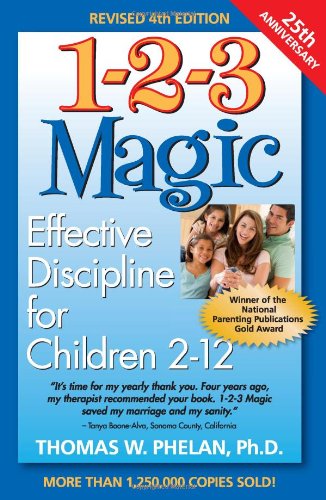
1-2-3 ... Magic?

I finished 1-2-3 Magic: Effective Discipline for Children 2-12 by Thomas W. Phelan, Ph. D. about a week ago. Like the other parenting books that I've read, there are some things that I really liked and others that didn't really strike a chord with me.

Image from childdevelopmentinfo.com
Let's start with what I liked:

  • The assertion that kids (especially small kids) don't get much--if anything--out of moralizing. E.g. 4-year-old Johnny is getting upset that 1-year-old Sally is playing with his toys. Johnny's mother tries to explain that it's important to share, while Johnny just gets more and more frustrated at Sally for the way she's playing with his things. He doesn't really 'get' the idea of sharing, and doesn't want to listen now.
    • The author calls this situation--when adults try to reason with small children--the "little adult syndrome", meaning that parents are treating children like little adults.
  • The 1-2-3 method: Each time the child misbehaves, count one number until you get to 3. At 3, the child has just earned a time out for as many minutes as they are years old. Aside: this method is only for behaviors that need to stop. Getting a child to do something (e.g. getting ready for bed) requires a different parenting method.
  • When a child feels loved, they are more likely to cooperate with what the adult wants them to do.
  • Parents need to watch out for their own temper tantrums when frustrated with a child for not cooperating.
  • One-on-one time is essential for good parent-child relationships.
  • Listening to children without judgement (if discipline is needed, that can come later)
  • Family meeting (I think this section should've gotten a little bit more attention)
  • The idea that a simple time-out--even when the child enjoys that time playing in his or her room--is enough of a consequence to make an impact on the child. The author asserts that the interruption to what the child is doing is enough in and of itself. I agree.
  • The suggestion to establish routines. The author didn't go into much detail here, but if we do everything the same way every day, then autopilot can kick in and there won't be as much resistance among the kids--or so I hope!
I didn't really like the author's ideas for helping children to start good behaviors--or maybe it was his way of presenting the tactics that I didn't like. I feel that a parent who isn't really very good with children or getting children to cooperate could make the situation a lot worse after reading this section. While the author mentions the need for positive reinforcement and having a good relationship with children for his strategies to work, he didn't emphasize it enough for my taste. I feel that some parents who are used to coercing their children into doing things would just use his strategies for more coercion. That is NOT good. Not only does coercion harm parent-child relationships, it also makes the child associate negative feelings with the tasks that he or she is forced to do. I think this problem could have been avoided if the author had made his ideas for strengthening parent-child relationships a more essential part of his section on "start" behaviors. 

I think that was my main beef with the book--the ideas were good, but some of the good ideas were downplayed, while tactics that could be implemented either positively or negatively were emphasized. 

Oh, one more thing--the book is supposedly for children 2-12. I think that the tactics presented would be more effective for younger children than for older ones. It's been a while since I was 10, but I think that some of these tactics would have rubbed me the wrong way at that point in my life.

Tuesday, February 19, 2013

Showing love to children

Lately I've been reading different parenting books to get several different perspectives on parenting and what works. I plan on picking and choosing what I think will work best from these books and combining them (and leaving out the the stuff I don't agree with).

The book that I'm currently reading has some good tactics, but there is one sentence that I just outright disagree with:
"Unless you are a grossly neglectful or abusive parent, your kids know that you love them."
Really? I have a story I'm going to share that contradicts this, but it's not this black and white. To the author's credit, the next sentence is this:
"By all means, tell them that you love them, but not when they're pulling a #4 on you." (A #4 is the manipulation tactic that the author is discussing)
___________________________________________ 

So my beef is with the first quote. "Unless you are a grossly neglectful or abusive parent, your kids know that you love them."

No, your children don't know that you love them unless you make it a point to make sure that they do! Here's my story:

Once upon a time, a long time ago when Katie was just a little girl, she didn't want to do her chores. When Mom asked her nicely to do her chores, Katie said she just wanted to keep playing. Her mom started getting upset because Katie always responded like this, and Mom just didn't know what to do. Mom wanted Katie to grow up to be a self-sufficient and responsible adult, and she knew that doing chores would help Katie to achieve this goal. So Mom said, "You are going to do your chores NOW, young lady!" 

Katie logically concluded that Mom must hate her because she was interrupting Katie's fun playing to make her do chores, which Katie didn't want to do. So Katie said what was self-evident: "You hate me! I'm not going to do my chores!"

Mom was heartbroken. How could one of her children that she treasured and adored think that she hated her? This had to be remedied. She said, "No, Katie, I love you! That is why I'm asking you to do your chores--because I love you so much."

This didn't make sense to Katie. It hurt her that her mom said she loved Katie when Mom obviously didn't love her.

(Aside: This is what the author was talking about when he said there are times when you shouldn't tell your child that you love them. Boggles the mind, huh?)

Now, if Katie had extended her logic a little further and hadn't thought about herself quite so much, she might have been able to figure out that Mom actually did love and cherish her. Mom cooked nutritious and filling meals for a crowd of ungrateful and ravenous children--including Katie--without complaining (much), she took her children to interesting places and fun parks, and made sure that birthdays and Christmases were special--which was especially hard in Katie's case, because Katie's birthday was just a few days before Christmas (Mom succeeded, because Katie never felt cheated by having a birthday so close to Christmas except for the fact that she never got summery things for her birthday, like a water gun). Mom also took Katie seriously, which was vastly important to that little girl. There were many other ways that Mom acted out her love for Katie, too many to list all of them. 

The point is that even with all this love showered on her, Katie didn't know that her mother loved her. Her mom was not "a grossly neglectful or abusive parent," but somehow Katie did not know she was loved. The problem was that her mom was uncomfortable with--or maybe just not in the habit of--telling her family that she loved them.

I believe that Katie hearing Mom say that she loved her at appropriate times would have solved Katie's problem, but not all children experience love in the same way.

I know a mother of nine children, and her children adore her. It is obvious that they each know of their mother's love. How does she do it, especially with NINE children? Well, I asked her one day. She was very modest about it and gave me some really great advice. The thing that stuck out the most to me was that she pays attention to how her children show love to her and she reciprocates love in a similar manner. If one child is always writing little love notes to his mom, then the mom writes love notes back. If one child always wants to do something with her mom, then the mom will make time to spend with that child. If a child gives gifts to the mother, the mom will give small gifts back. This really struck me because one of the biggest life lessons I learned on my mission is that everyone is different and because of that, people need to be treated differently to communicate properly with them. 

Anyway, I'm getting off subject. The point is, don't just love your children. Make your children know that they are loved. Understand that what makes you feel loved won't necessarily be the key to make them feel loved, so pay attention to how they love you and respond in kind.

Wednesday, February 6, 2013

"Positive Discipline": My take

I recently read a book called Positive Discipline. It is, of course, about how to discipline positively. The book focuses on parent-child relationships and teacher-student relationships. I wanted to remember what I liked and didn't like about it, so here's a quick run-down:

Liked:
  • Detailed information on how to hold a family council (or family meeting, as the book calls them) or a class council.
  • The idea that "kids these days" are less well-behaved and are more "sassy" than kids 50 years ago because kids no longer have adult models of submission and obedience. Women no longer submit to their husbands the way they used to (thank goodness!), and "it is difficult to find anyone who is willing to accept an inferior, submissive role in life."The author states that it's great that there are so many more freedoms now than 50 (or 60 or more) years ago, and it's wonderful that our children are growing up in this world with so many freedoms. However, parents need to take up the slack.
    • Here the author reviews 3 kinds of discipline: controlling, permissive, and "positive" discipline.
  • Getting children to cooperate by allowing them to be part of the decision on what the consequence should be
  • Not punishing children, but disciplining them. If you punish a child, they are humiliated. If you discipline a child, the child experiences natural or logical consequences that helps them to stop behaving poorly. Sometimes the child enjoys going through with these consequences (e.g. if sent to his/her room, the child may enjoy playing with toys while there. That's ok).
  • Information on the benefits of a "cooling-off" period. 
  • The idea that children who misbehave are misbehaving to achieve a goal--whether they know it or not. The primary goal is to achieve belonging and significance. Secondary goals (to acheive the primary goal) include:
    • Attention
    • Power
    • Revenge
    • Assumed inadequacy (this isn't really a goal, but the author asserts that when children are suffering from assumed inadequacy, they think something like, "I do not feel that it is possible for me to belong and have significance, so I will give up and hope people leave me alone."
  • How encouragement is different from praise
  • True stories were used to illustrate concepts

Disliked:
  • Didn't really talk about children who are well-behaved and perform well but need more attention. Although this is a book about discipline, there were several places that I think it would have been useful to mention that some children who are obedient and appear to be happy need to acheive belonging and significance just as much as their misbehaving counterparts.
  • The book was written in the 1980's. It's a little outdated.
  • You have to work to get through the book.
Overall, it was a really helpful book. I really liked the ideas presented in it and would like to review it again in a few years to refresh that part about family councils. I'd also like to review the chapter on mistaken goals, because it had some good stuff about how to recognize and deal with each mistaken goal.

Tuesday, February 5, 2013

Wrestling vs. cuddling with kids

I'm reading Playful Parenting by Lawrence J. Cohen, and I just got to an interesting part about wrestling. The author says:
"Active children may do better with active cuddling than the sit-quietly-on-the-lap type of cuddling."
Really? I had no idea that wrestling ("active cuddling") could be on the same plane as the traditional type of cuddling.

What do you think? Can wrestling be a good substitute for cuddling when the kids don't want to cuddle very much?